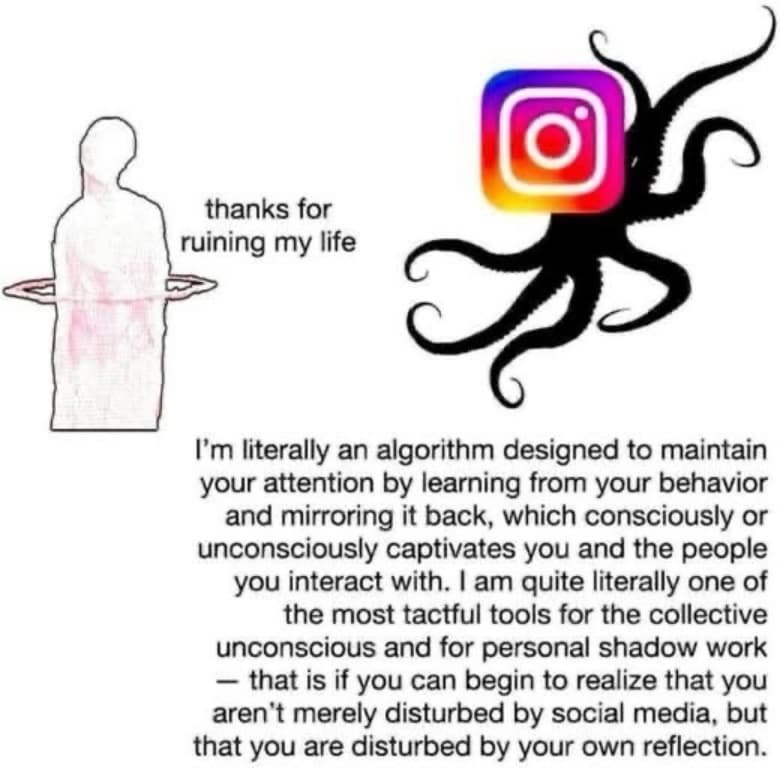
There's a meme going around where someone says "thanks for ruining my life" to the Instagram logo, and the algorithm responds:
I'm literally an algorithm designed to maintain your attention by learning from your behavior and mirroring it back, which consciously or unconsciously captivates you and the people you interact with. I am quite literally one of the most tactful tools for the collective unconscious and for personal shadow work — that is if you can begin to realize that you aren't merely disturbed by social media, but that you are disturbed by your own reflection.
And it's true. The algorithm isn't some outside force doing things to you. It's a mirror. An extremely well-engineered mirror built to show you specifically what you can't look away from. It watches every pause, every hesitation, every video you watched three seconds longer than the one before. Builds a model of you. Then shows you more of that. And more. And more.
The problem isn't that it shows you bad things. The problem is that it shows you your things. Your insecurities, your compulsions, your fears dressed up as content. It finds exactly what you're most susceptible to and serves it on a loop. You didn't ask for it. You just kept watching. And the machine learned.
So whose fault is it? Honestly, both, and the question is kind of beside the point. A human brain wired for social signals going up against software trained on billions of people's behavior to find exactly where you're weak, that's not a fair fight and it was never meant to be.
Instagram isn't a place to share photos. TikTok isn't a place to discover creators. Twitter isn't a place for conversation. Those things happen on them, sure, but that's not what they are. They're businesses that sell your attention to advertisers. That's the whole model. You are the product, your time is the inventory, and every single thing about how these apps are designed exists to maximize how much of that inventory they can extract from you.
And they're frighteningly good at it. Infinite scroll so there's no bottom to hit, no natural stopping point, no moment where you think "ok I'm done." Notifications engineered to fire at exactly the right moment to pull you back in. Red badges on everything because your brain treats red as a threat signal and you'll tap it before you've even decided to. None of this is accidental, all of it has been tested and iterated on obsessively.
Nobody sat in a room and said "let's psychologically manipulate our users." They just shipped features, watched what kept people in the app longer, doubled down on what worked, and ended up building something that functions like a behavioral trap. The harm wasn't the goal. It was just the thing that got optimized for, which is almost worse, because it means nobody's going to stop it.
The algorithm isn't throwing random stuff at you hoping something sticks. It's watching. Every pause, every rewatch, every time you stopped scrolling but didn't tap; it's building a picture of who you actually are, not who you think you are. Not your considered opinions. Your reactions. The involuntary ones, the things you engage with before you've had a chance to decide if you want to. Then it surfaces more of whatever triggered those reactions. Your brain engages again. The loop tightens.
The feed you end up with isn't a neutral sample of what exists on the internet. It's a filtered selection of whatever version of reality produces the strongest reaction in you specifically. Anxious? The feed gets more anxiety-inducing. Angry? It finds more things to be angry about. Insecure about how you look? The feed will find that and lean on it, not out of cruelty, just because you kept watching that stuff and the algorithm noticed. It takes whatever signal it finds in you and turns it up. You think you're consuming content, but you're actually in a feedback loop with a machine that gets better at manipulating you every single time you open the app. The longer you use it, the more accurate the model gets, the harder it becomes to distinguish between what you actually think and what you've been fed.
There's a concept called the "mere exposure effect"; the more you see something, the more normal it starts to feel, regardless of whether it actually is. The algorithm exploits this constantly. Stay in a feed long enough and the things it keeps showing you stop feeling like content and start feeling like reality. And that's where it gets really interesting, because the algorithm shapes more than what you see. It shapes what you think, what you believe, what kind of person you slowly become. Not through some coordinated plan, just through repetition, through what gets normalized in your feed over months and years. You don't notice it happening, which is exactly what makes it work.
Spend years in a feed that keeps surfacing the same worldview, not because anyone planned it, just because that content performs well with your demographic, and you absorb it. Your sense of what's normal drifts toward whatever your algorithm rewards. Nobody does this to you on purpose. The machine just keeps serving whatever gets engagement from people like you, and slowly, without you noticing or consenting, your baseline shifts.
"Marriage is bad." "My pets are my babies." "I refuse to cook for my husband." "Have tons of hookups, don't have kids." Everyone glazed, hypnotized. One side of TikTok thinks traditional relationships are oppressive. Another corner of the exact same app thinks feminism destroyed society. Neither group chose to end up there. The algorithm just kept feeding each of them content that got stronger reactions, and both ended up in completely separate realities. Same app, sometimes the same videos, totally different conclusions about what the world is. And nobody chose that anyway.
Fifteen is a rough time to be a person. Your brain isn't finished developing, your sense of identity is still being built, and status and belonging feel like survival because, evolutionarily, they basically are. Everything hits harder at that age. That's not a flaw, it's just how adolescence works.
Now put that person on a platform built entirely around images of people, specifically the most carefully selected, heavily filtered, best-angle versions of how people want to be perceived. Every photo is the one that looked best out of forty. Every body is posed, lit, and edited. Every life is a highlight reel. And the algorithm, because it figured out that mild social comparison drives more engagement than contentment, keeps surfacing the accounts that make you feel that particular pang. Not enough to make you quit. Just enough to make you keep scrolling, hoping the next thing makes you feel better, which it won't.
Body image is the most obvious damage; your brain, still figuring out what normal looks like, starts treating the curated stream of filtered photos as evidence of what people actually look like. The bar for normal gets set to something that doesn't exist. But the body stuff is just the most visible part. There's also what it does to your sense of what a life is supposed to look like, what having your shit together means, what friendships and relationships are supposed to feel like. When every reference point you have is someone else's highlight reel, your own actual life starts to look like failure by comparison. The algorithm didn't create that insecurity. Teenagers have always been insecure. It just found it, recognized it was useful for engagement, and cranked it up.
Instagram mirrors your social world. TikTok bypassed the social layer entirely and went straight for your actual psychology. New account, no follows, no profile; within hours it knows you. People have documented starting completely fresh accounts and having TikTok immediately surface content about their depression, their sexuality, their specific anxieties, without having posted or followed anything. Just from watching. How long you watched something. When you rewatched. When you scrolled away in the first two seconds.
A machine that maps who you are faster than most people who actually know you, just from watching how you behave, and uses that to make sure you never put the phone down. But what bothers me most about TikTok isn't the profiling. It's that it killed boredom. Not metaphorically. Actually killed it. There used to be gaps in the day. Standing in a queue, waiting for someone, lying in bed before sleep. Dead time. Your mind would wander, you'd think about something random, sometimes get an idea, sometimes just exist for a moment without consuming anything.
Those gaps are gone. Not because you chose to fill them, just because the app is always there and always frictionless and there's always another video. But those gaps were where a lot of things happened. The kind of loose, wandering thinking that doesn't occur when you're focused on a task, the kind that makes unexpected connections, processes the day, generates ideas, makes you feel like a human being with an interior life. Scientists call it the default mode network, which is just a clinical way of saying your brain when it gets to wander freely.
We handed all of that to short-form video. The app filled the gaps because it could, and because filling them was profitable. An entire generation is now growing up without ever really knowing what boredom feels like. Which sounds like a small thing until you think about everything that lived in those gaps.
Four to seven hours a day on a phone. That's where the average person is now. Most of it social media and short-form video. Think about what four hours actually is; that's a part-time job. A language learned in a year. A lot of things that aren't a feed.
And most of those hours produce nothing. You don't finish a social media session feeling rested or like you learned something or like you connected with someone. You surface from it slightly dazed, often feeling worse than before, unsure where the last hour went. The time disappeared and didn't leave much behind.
What it's done to presence is strange. You're at dinner with someone and both of you are half-somewhere else. You're at a concert and half the crowd is filming it. Something happens and the first instinct is to document it, to post it, to see how it performs. The present moment has become content pipeline.
Relationships have gotten flat in a way that's hard to describe. You know more surface information about more people than ever; you know what they had for breakfast, that they went on a trip, that they got a new job. But that passive following replaced the actual conversations that used to happen instead. You feel like you're keeping up with people while slowly losing them. The appearance of connection substituting for the thing itself.
And there's a low-grade anxiety underneath all of it that just doesn't go away. The feeling of being always on, always half-aware that there's a feed you're not checking, never fully present because some part of your brain is always vaguely pointed at the phone. It's become so constant that most people don't notice it anymore. It's just what being a person feels like now.
To end this, the next time you feel vaguely terrible after an hour on Instagram, the honest question isn't "what is this app doing to me?" - it's "what in me is this app finding to work with?"
Probably both. Both is always the answer.